History

Our History

The Formation

“Mom! Quick! I have a remarkable story to tell!”, a young boy shouted, excitedly, as he rushed to the kitchen to find his mother. Indeed, how can anyone not deem the story of the Boys’ Brigade as a remarkable one? As the pioneer of uniformed organisations for youth, even before the formation of the Scouts, the Boys’ Brigade grew from this one Company, formed in Scotland, into an international movement that changed the lives of many young people.

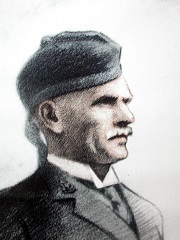
It all began on the 4th of October, in 1883, Glasgow – the land of the Scots. William Alexander Smith, who was a teacher at that time, served as a Lieutenant with the volunteers on Saturday afternoons. William Smith was concerned about the lack of discipline amongst the boys in his Sunday School class, some of whom were over 13 years old and already working for a living.

He had difficulty keeping the rowdy boys in his class quiet in order to teach them. But on Saturdays, as an Officer in the Volunteers (part of the army of that time), he could get a hundred men to obey his every word of command. Why couldn’t the Boys in his Sunday school be like the Volunteers.

On one fine day, Smith shared his idea, to combine military drill with group physical exercises and religious instruction, with his two friends, in which they later invited boys from North Woodside Mission Sabbath School and formed the first company of The Boys’ Brigade – the 1st Glasgow Compan at Free Church Mission Hall, North Woodside Road, Glasgow. 

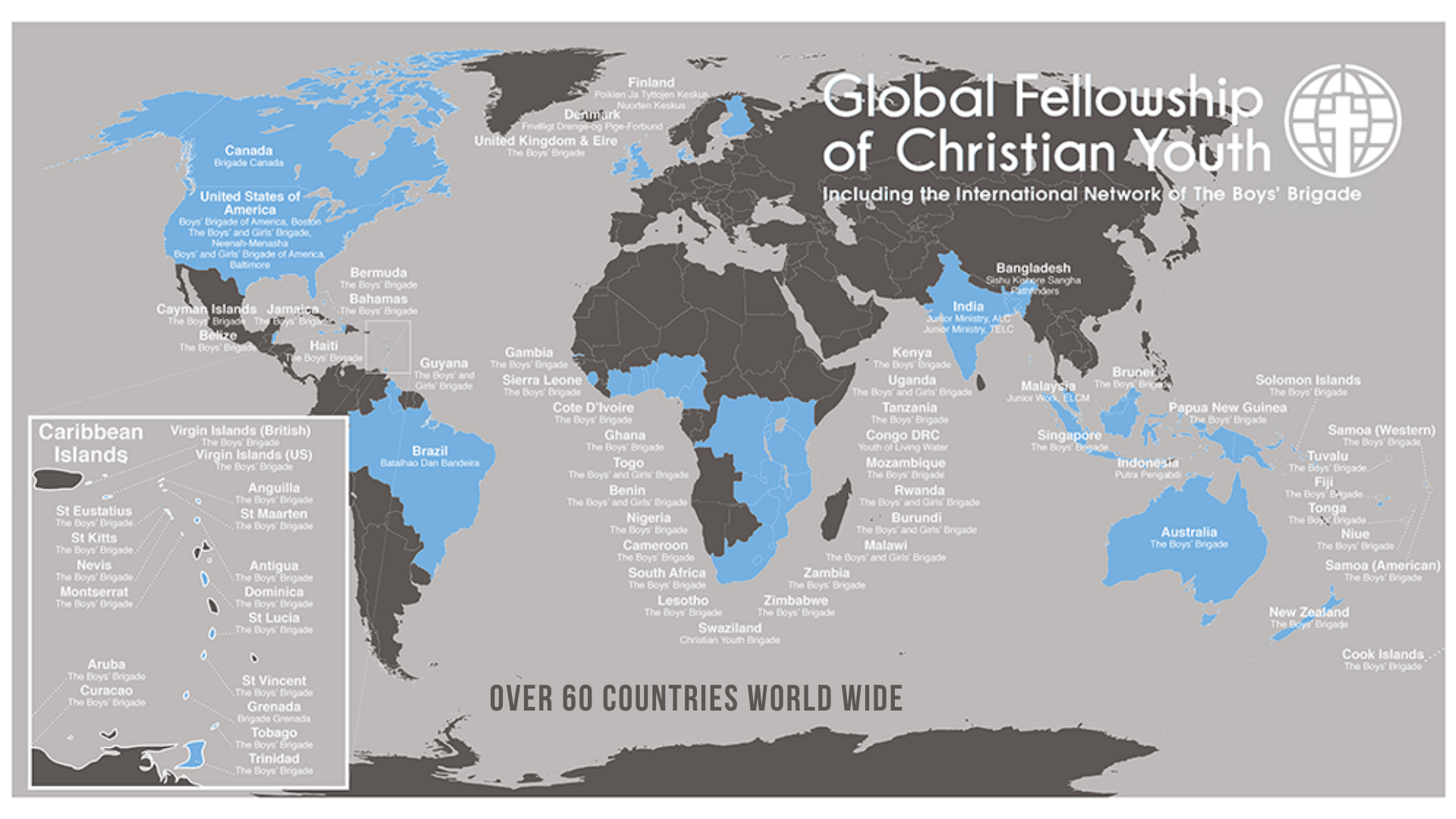
Thus, the Boys’ Brigade was started. Very quickly, it was clear that the Boys benefited from The Boys’ Brigade. It was the first uniformed organisation in the world and has since grown to be a worldwide organisation. The Boys’ Brigade movement is now in more than 60 countries.

The Boys' Brigade in Malaysia

The Boys’ Brigade (BB) was founded in Glasgow, Scotland on 4 October 1883, by Sir William Alexander Smith. It spread rapidly to North America, Europe, Africa, Australia and New Zealand. However, the BB did not appear in the Asian scene until 1915, when the first Company was founded in the Chinese city of Swatow by the Rev Guthrie Gamble (the famous Swatow BB was to become a legend in later years in China). The BB came to South East Asia in 1930 with the founding of the 1st Singapore Company by Mr James Fraser.

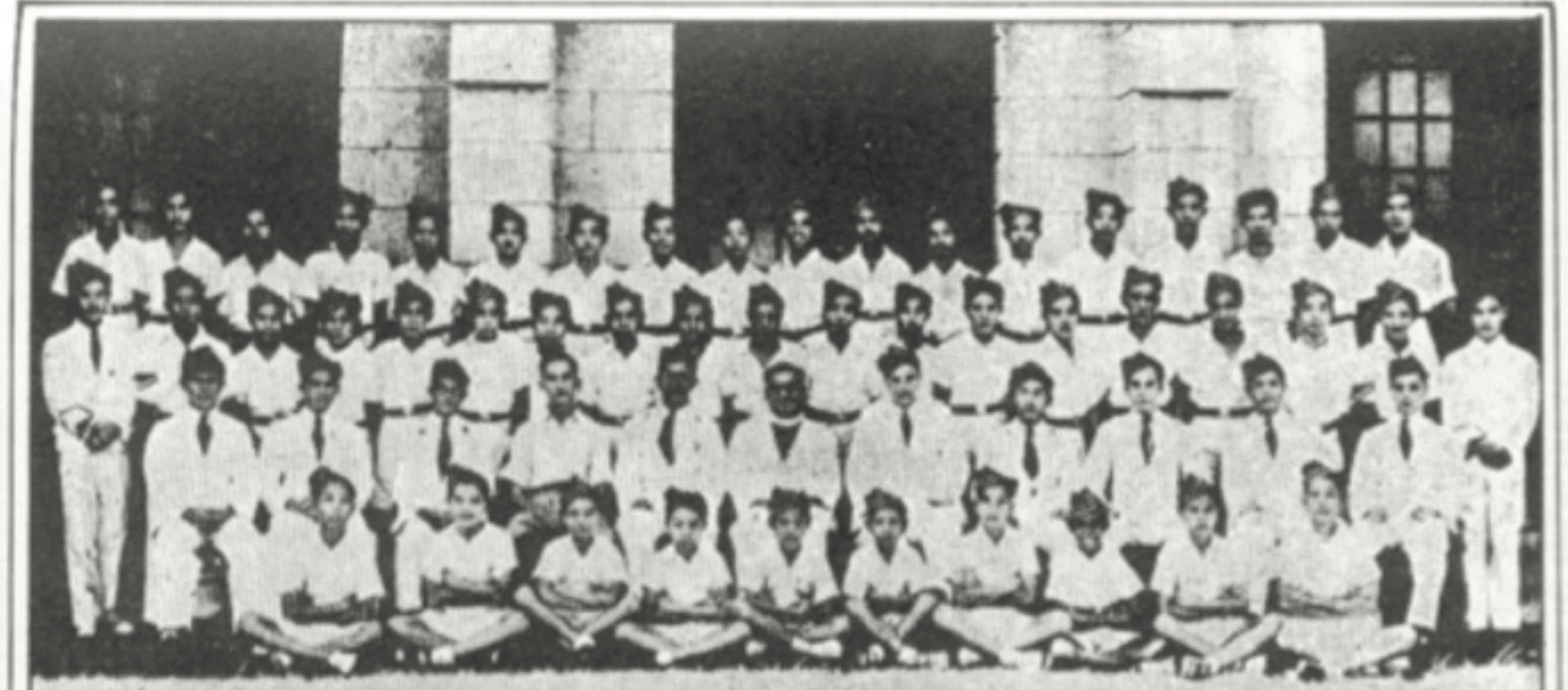
The Boys’ Brigade did not come to Malaya until after the Second World War. A British soldier, by the name of Robert Davis (a former Captain of 6th Birkenhead Company at the Tranmere Freehold Methodist Church and later Tranmere United Reformed Church), gave the idea of The Boys’ Brigade to one of Penang’s great educationist, the late Mr Geh Hun Kheng, who accepted the challenge of becoming the first BB Captain in Malaya. Mr Geh realised that he had to do his “small share” to win the Boys over from the various subversive groups, that were so rife after the Pacific War. The first meeting of 20 Boys was held in one of the Methodist churches in Madras Lane, on a Sunday in September 1946. Penang, thus, became the springboard from which Companies were started first in Kuala Lumpur and then in other parts of the country. When Malaysia achieved independence on 31 August 1957, The Boys’ Brigade was given the honour of being invited to take part in the Merdeka Parade (Independence Day Parade).

After Merdeka (Independence), The Boys’ Brigade began to spread rapidly, due to the formation of the Malayan Council of The Boys’ Brigade, under the initiative of Mr Khoo Oon Soo. Hence, more Companies were founded in every major town in Malaya. As time progressed, with efforts, even small rural towns began to have BB Companies functioning efficiently. By this time, a firm and friendly contact had been made with the BB in Singapore, which helped in the supply and sale of equipment and with the founding of the first Company in Borneo in 1959, the 1st Kuching Company. In 1962, the BB in Malaya became a member of the Pacific Regional Fellowship (and subsequently joined the later-formed East Asia Regional Fellowship), and the first Pacific camp was held, with the co-operation of the Singapore Battalion, in Port Dickson, in December 1963.

On 5 December 1964, the (former) Federation of the Malayan Council of The Boys’ Brigade, the Singapore Battalion and the 1st Kuching Company merged into The Boys’

Brigade in Malaysia.Unfortunately, with the political separation of Singapore from Malaysia, The Boys’ Brigade in Singapore ceased to be a component District of The Boys’ Brigade in Malaysia, as of 19 August 1965. With Malaysia becoming a reality, the National Council began to establish Companies in Sabah and Sarawak, whilst maintaining friendly ties with the BB in Singapore.

The development of The Boys’ Brigade in Malaysia took a revolutionary turn, when it invited girls to be members. It was first introduced in 1989 and was debated for a few years before experimental measures were approved in 1992. The move received favourable response and strong support from churches and individuals. On 2 April 1994, the National Council adopted the proposal to allow Girls to join the Boy’s Brigade. Thus, a section, called the “Girls’ Wing”, was incorporated. As at today, over 20 companies in the BBM have girls on their membership roll, and many girls have been appointed NCOs, and they have proven to be capable in adapting well to the activities of the BB.

Since 1992, The Boys’ Brigade in Malaysia had also begun to play a significant role in the extension of BB work in the East Asia Regional Fellowship, including conducting training and supporting BB works in Indonesia, Thailand and the Philippines.

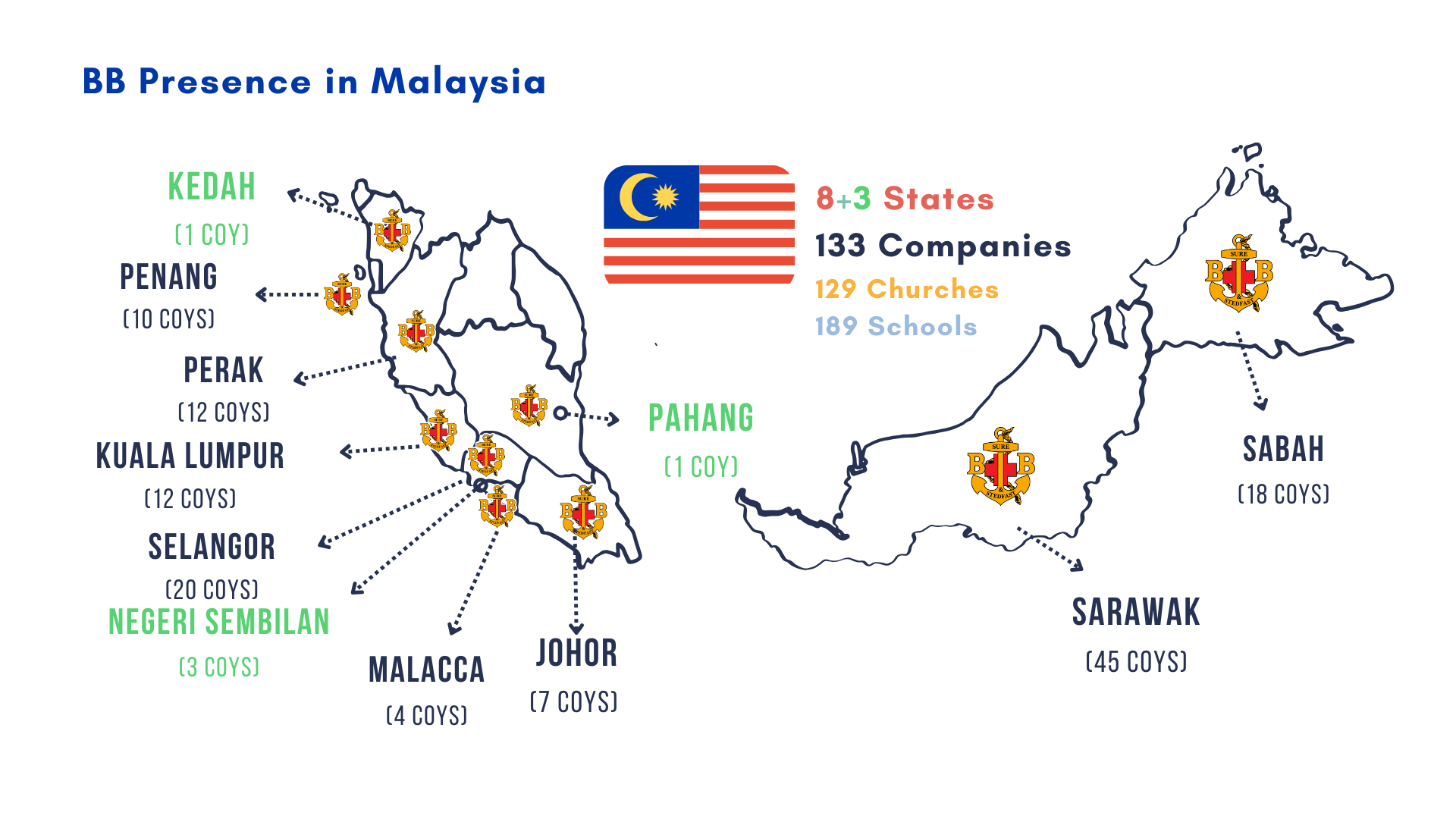
Today, there are over 133 Companies spread throughout the length and breadth of Malaysia.

The Boys’ Brigade in Malaysia has come a long way, since its establishment in 1946.Many things have, since, changed. Many have come and gone, with many new developments taken place. Throughout these years, the BBM has been able to hold on to its object and continue in serving the youth of Malaysia. As the nation is fast-moving towards greater heights in development, it is believed that the BB shall be called on to play an even greater role, in the development and training of the Malaysian youths.
  • 70th Anniversary of BBM

    20 Jul,2015

  • Founding of 2nd Kuala Lumpur

    2nd KL was founded by Mr Cedric Park at Grace Methodist Church in August 1957.

    26 Aug,1957

  • From church youth work to a national movement

    Meanwhile, the 1st Glasgow Company continued to increase its membership and enhanced its programme. Activities such as swimming, cricket and a brass band which superseded the flute band, were incorporated.

    View more

    30 March,1885
  • 1st Glasgow Company

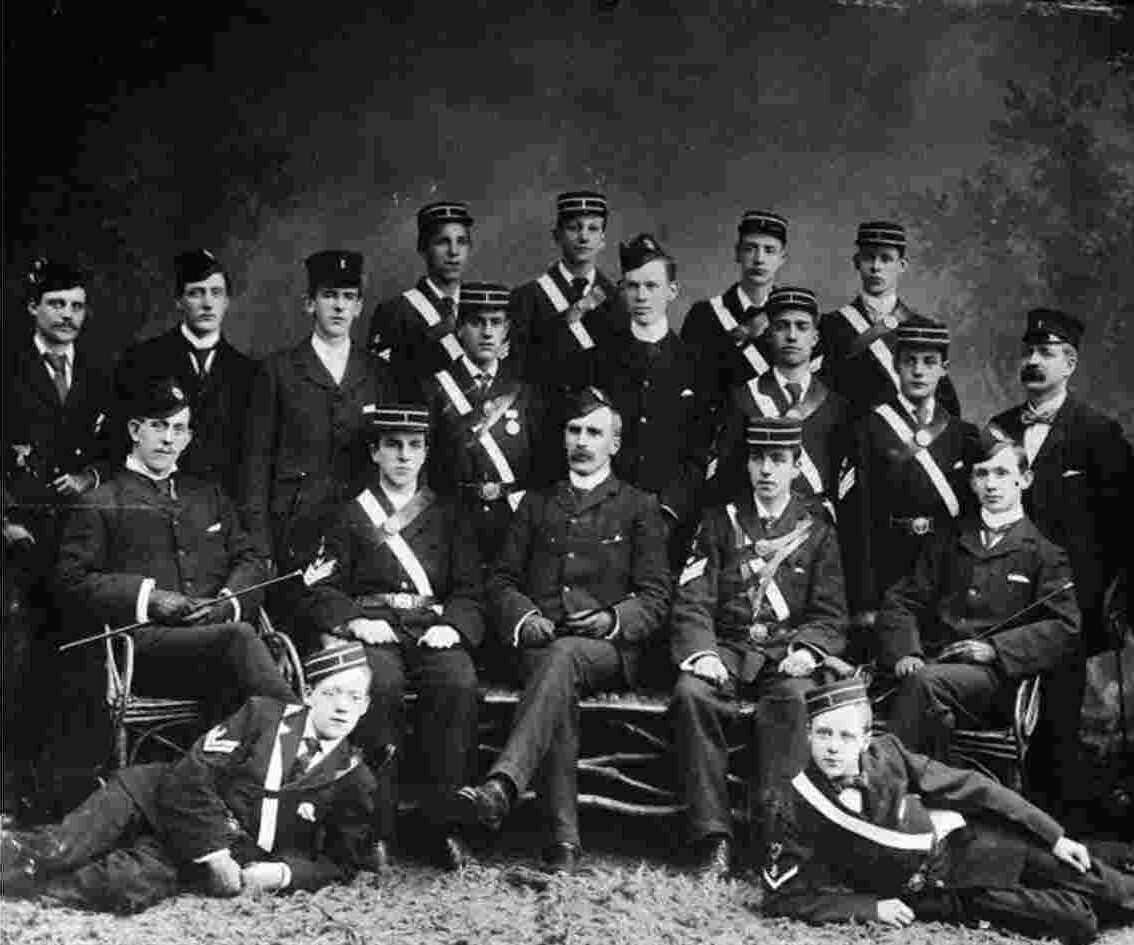
    The Boys' Brigade was launched in the Free College Church Mission, North Woodside Road, Glasgow on 4 October 1883 with a crew of three Officers and 28 Boys.

    View more

    04 Oct,1883
  • The Founding of The Boys

    It was in his twentieth year that Smith started active work in the Free College Church in Glasgow. He served as a Sabbath School (or Sunday School) teacher there.

    View more

    01 Jan,1883
  • The Early Years of our Founder

    William Alexander Smith was born on 27 October 1854 at Pennyland House, half a mile from Thurso. Thurso is a town of 4000 inhabitants, situated on the north-eastern coast of Scotland.

    View more

    27 Oct,1854

The Early Years of our Founder

27 Oct,1854

William Alexander Smith was born on 27 October 1854 at Pennyland House, half a mile from Thurso. Thurso is a town of 4000 inhabitants, situated on the north-eastern coast of Scotland, where the Thurso River runs into the sea. Smith was the eldest son of Major David Smith and Harriet Fraser. He was educated at the Miller Institution, known as the “Thurso Academy”.

In 1868, when Smith was 13 years old, his father passed away in Swatow, while on business as a director of the Labuan Coal Company. Mrs Smith accepted the offer of her brother, Alexander Fraser to take the eldest Boy into his home and later into his business in Glasgow. In January 1869, Smith enrolled as a student in the private school, The Western Educational Institution, more widely known as Burns’ and Sutherland’s School. He continued schooling until the age of fourteen and a half. In October 1869, he joined his uncle’s business as a clerk. Alex. Fraser & Co. was a wholesale dealer in “soft goods”, with shawls being a principal line and South America its primary market.

In those days, it was customary for young men of spirit to join the Volunteers. Hence in 1873, Smith followed the military path of his father and grandfather, who were officers in the army, by joining the 1st Lanarkshire Rifle Volunteers. He progressed steadily in ranks, rising from corporal in 1874 to Lieutenant-Colonel (second-in-command) in 1905.

Share by : jave (The Boys’ Brigade in Malaysia)
Last modified: 06-03-2020

The Founding of The Boys

30 Jan,1883

It was in his twentieth year that Smith started active work in the Free College Church in Glasgow. He served as a Sabbath School (or Sunday School) teacher there. When he encountered rambunctious teenage Boys, he sought to discipline them through drill and espirit de corps. He then had the idea to band together Boys above the age of twelve into a “Brigade”, in which they would be taught elementary drill, physical exercises, obedience to the word of command, punctuality and cleanliness. Organised games would also be part of the programme. He presented this concept before the Woodside Mission authorities. Permission was given for this experiment to be tried.

He roped in a fellow member of the 1st Lanark, James R Hill, who was also a teacher in the Sunday School. A third Officer who had similar credentials, John B Hill, was also recruited.

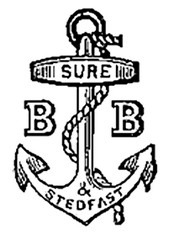
They decided upon the following: the name – The Boys’ Brigade; the Crest – an anchor; the Motto – Sure & Stedfast (taken from King James Version Hebrews 6:19); Membership for all Boys aged twelve to seventeen; and the Object – The advancement of Christ’s Kingdom among Boys and the promotion of habits of Reverence, Discipline, Self-Respect, and all that tends towards a Christian Manliness.

Some ten years later, Obedience was added to the Object of the Boys’ Brigade. Manliness has also in some countries been replaced by the gender neutral ‘character’ since there are now girls who may also join The Brigade.
Share by : jave (The Boys’ Brigade in Malaysia)
Last modified: 15-05-2019

1st Glasgow Company

04 Oct,1883

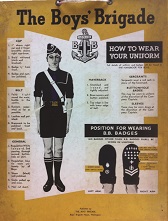
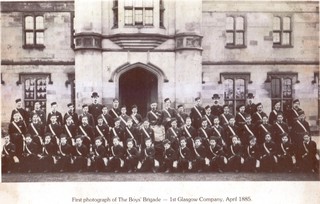
The Boys’ Brigade was launched in the Free College Church Mission, North Woodside Road, Glasgow on 4 October 1883 with a crew of three Officers and 28 Boys. Smith was the Captain and the Hill brothers were Lieutenants. It was agreed at the on start by Smith, James and John Hill that however the Brigade might develop, the only ranks should be Captain and Lieutenant. The BB is the world’s first uniformed youth organisation. Within the first three weeks, a total of 59 Boys were recruited and strict discipline was enforced within the organisation. In the first session, the Boys did not don on any special attire. It was only in the second session where the haversack, pill-box cap and brown leather waist belt with the BB crest embossed on the buckle were introduced. The addition of a cross-belt for Sergeants came a little later. The Officers sported a small red rosette pinned to the lapel of their jackets. A year or two later, the Officer’s uniform comprising of a dark blue suit, glengarry cap with badge, tan gloves and a cane was adopted.

By November 1883, 35 Boys remained on the roll for formal enrolment. In December of that year, the Brigade leaders organised an examination for promotion. Drill, written work, conduct and character were taken into careful consideration. At the end of the exercise, there were two Sergeants, two Corporals and two Lance-Corporals. The Company was divided into six squads, with these Non-Commissioned Officers heading each squad.
Share by : jave (The Boys’ Brigade in Malaysia)
Last modified: 16-06-2019

From church youth work to a national movement

30 Mar,1885

Meanwhile, the 1st Glasgow Company continued to increase its membership and enhanced its programme. Activities such as swimming, cricket and a brass band which superseded the flute band, were incorporated. On 30 March 1885, five new Companies were enrolled as follows: 1st Glasgow Company (North Woodside Mission), 2nd Glasgow Company (Berkeley Street U.P. Church Mission, now Blythswood Church), 3rd, 4th, 5th and 6th Glasgow and 1st Edinburgh.
Share by : jave (The Boys’ Brigade in Malaysia)
Last modified: 16-05-2019